
If you know which sail you are replacing, go straight to it. If you want to understand the whole wardrobe first, ask AI to build a recommended sail inventory for your boat.
Let AI plan the inventory
The boat establishes the rig and the space each sail has to work in. You add the part the boat record cannot know. The whole brief takes five choices and an optional note.
1 — Find the boat
Search by builder, model or class and select the right rig record. On the boat page or homepage sail list, choose Plan my inventory or Add inventory.
2 — Tell us how you sail
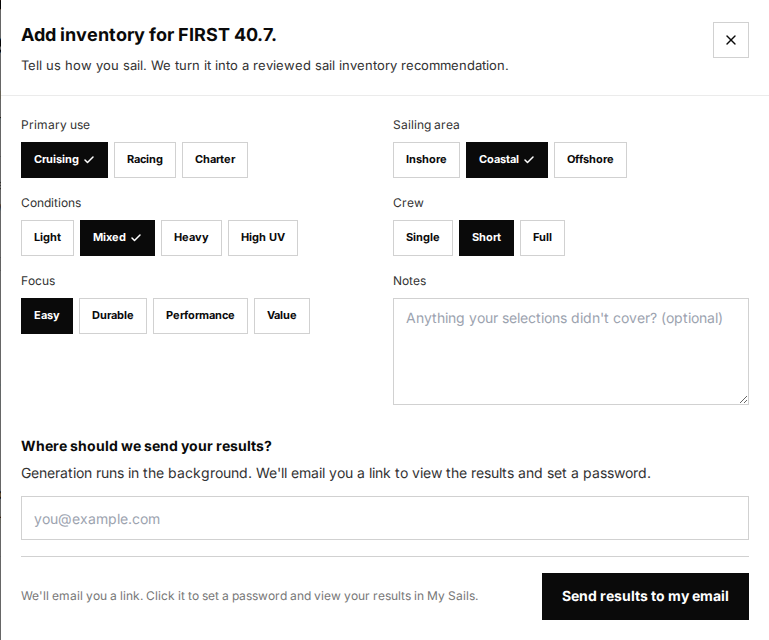
Fill the brief from what you actually do, rather than what sounds most capable:
- Primary use — Cruising, Racing or Charter. Select more than one only when the boat genuinely does both jobs.
- Sailing area — Inshore, Coastal or Offshore. This describes exposure and time away from shelter, not the boat’s home port.
- Conditions — Light, Mixed, Heavy and High UV. Select the conditions the sails must live with regularly, not the strongest day you can imagine.
- Crew — Single, Short or Full. Choose the crew that normally hoists, reefs and handles the sails; this changes which handling systems make sense.
- Focus — Easy, Durable, Performance or Value. This is the trade-off you want the recommendation to make when more than one answer would work.
- Notes — add a sail you already know you want, a problem with the current wardrobe, a rig modification, or anything the five choices did not express.
3 — Generate the recommendation
Choose Add inventory when signed in. If you are not signed in, enter your email and choose Send results to my email. Generation usually takes about two minutes and runs in the background, so you can continue browsing. Open the finished plan from My Sails or the email link.
4 — Read the result
AI combines those answers with the boat record and proposes a working inventory: the mainsail and headsails the boat needs, plus any reaching or downwind sail that earns its place for the way you sail.
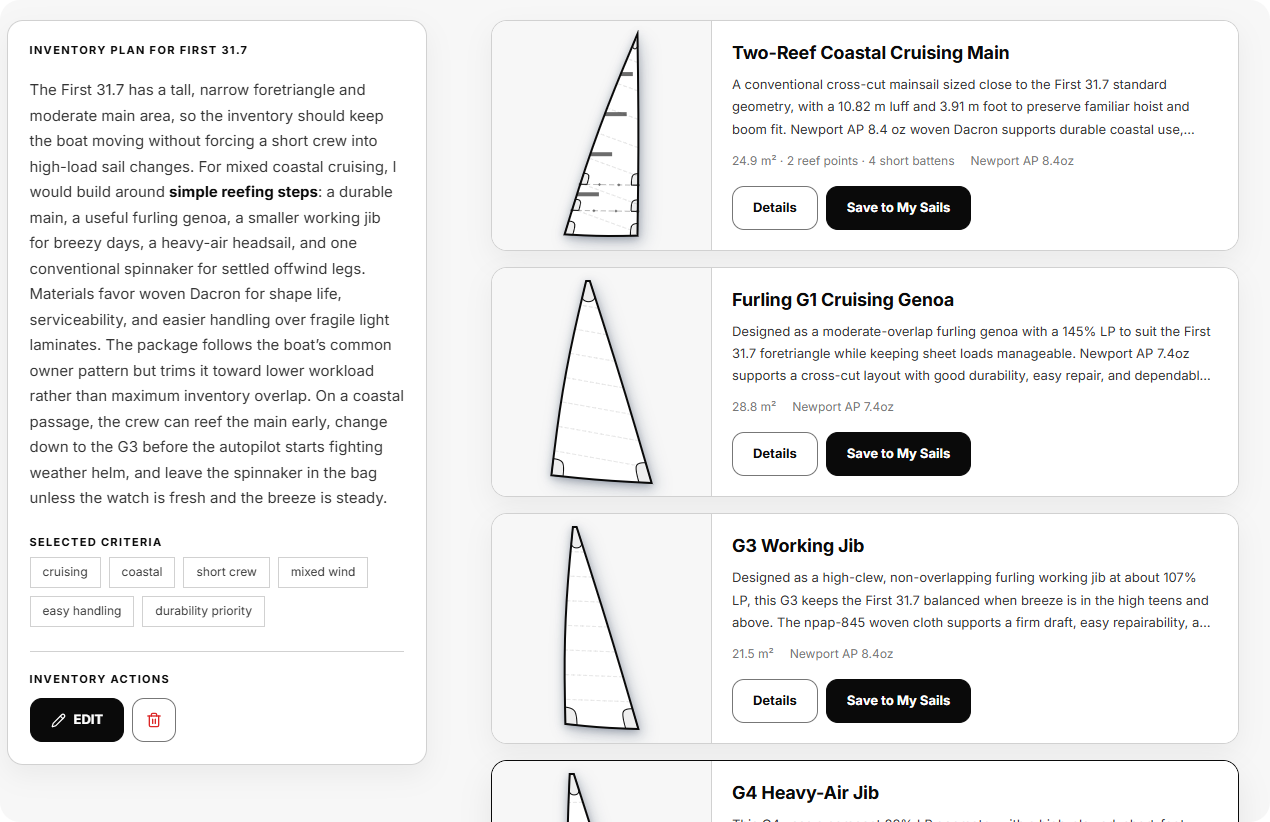
Read the page in this order:
- Inventory plan explains why this combination suits the boat and the sailing brief. Check that it describes the kind of sailing you actually do.
- Selected criteria repeats the priorities AI used. If an important condition, crew pattern or priority is wrong, choose Edit, correct the brief and generate the inventory again.
- Sail cards are the individual recommendations. The name tells you the sail’s job; the line beneath summarises its area, handling features and proposed cloth.
- Choose Details to inspect one sail’s geometry, material, construction and technical notes. In the detail window, you can also tell AI how to revise that sail — for example, “Prioritise durability over weight” or “Make this easier for two people to handle” — and choose Apply.
- Choose Save to My Sails only for a sail you want to take forward. This creates an editable sail draft in My Sails. Open that draft in the full Designer to check dimensions, handling, cloth and options before buying.
The result is a plan, not an order or a fixed package. Saving one sail does not save or buy the others, so you can configure one now and leave the rest for later. Edit regenerates the whole inventory from an updated brief; the bin deletes the whole inventory.
Or choose one sail directly
If the job is already clear — replacing the mainsail, adding a working jib, or buying a Code Zero — there is no need to generate the whole inventory first. Select the sail from your boat and configure it directly. Both routes end in the same Designer and receive the same sailmaker review after ordering.
If you are replacing a sail
Go to that sail’s guide. The one thing worth doing first is asking whether you want the same sail again.
The sail being replaced was specified by somebody — often the builder, often for a different owner sailing differently. Three things are worth reconsidering rather than copying:
Size. A headsail that is too large to tack cheerfully spends its life partly rolled, which means it is the wrong size. A mainsail with a roach that fouls the backstay was wrong from the start.
Reef count. Old mainsails are frequently reefed the way a previous owner sailed.
Cloth. If the last sail went soft in three seasons and that annoyed you, that is information.
If you are filling a gap
Every boat has holes in its sail plan. The question is which one costs you the most.
The wind is aft and the boat is slow
The most common gap. Once the wind goes aft of about seventy degrees apparent, the headsail is blanketed by the mainsail and stops working, and there is nothing between there and the engine.
Three sails fill it, and they are not interchangeable:
Gennaker — asymmetric, no pole, handled from the deck. Covers reaching to fairly deep running. For a boat sailed by two people this is almost always the right answer, and it is the sail that will actually get used.
Spinnaker — symmetric, on a pole. Goes deeper than anything else and needs the pole set and gybed. Right for boats with crew that genuinely run downwind; wrong for most cruising couples, and the lockers of the world are full of proof.
Code Zero — flat, on a cable, furled from the cockpit. Fills a different gap: tight-angle reaching in light air, where a gennaker’s luff collapses. If your slow days are close reaches rather than runs, this is the sail.
If you can only have one and you mostly reach, that is a Code Zero. If you can only have one and you mostly go downwind, that is a gennaker.
The boat is over-pressed too often
If you are reefing early, sailing with the traveller down, or rolling away half the genoa on ordinary days, the sail plan is too big for where you sail. Replacing like-for-like repeats the problem.
Heavy weather has no plan
If the answer to a gale is “roll the genoa away to a handkerchief and put the third reef in”, there is a gap. A rolled genoa is a poor storm sail for reasons set out in Storm Jibs, and a mainsail that cannot be lowered has no substitute unless there is a trysail.
This is not an upsell. It is the one gap where the consequence is not slowness.
What to replace first
If several sails are tired and the budget is not, the order is usually:
The mainsail, if it has lost its shape. It is up all the time, it affects how the boat behaves in every condition, and a bagged-out mainsail makes the boat heel instead of go.
The headsail, if the boat has stopped pointing. That is the first symptom of a stretched headsail and it is very noticeable.
A downwind sail, if you do not have one. This is the change that alters what days you can sail rather than how well.
A note on buying a matched pair
Mainsail and headsail work together, and there is a real argument for replacing both at once: the two are designed as a pair, the boat is balanced as a whole, and one new sail alongside one tired sail sometimes makes the imbalance more obvious rather than less.
There is an equally real argument against, which is cost. If it is one at a time, the sail that has lost its shape goes first.
When you are not sure
Start with the AI inventory. Describe what the boat actually does — where you sail, in what wind, how many people, what is missing and what annoys you. Those facts produce a more useful recommendation than asking which sail is best in the abstract.
Where this goes
Once you open one recommendation, Configuring a Sail explains the full Designer. The sail-specific guides take the choices further: Mainsails, Headsails, Code Zero, Gennakers, Spinnakers.