
A1-A5 is the common shorthand for asymmetric sail roles. It is not a quality scale, and the boundaries vary between sailmakers, so the number must always be read with the intended wind and angles.
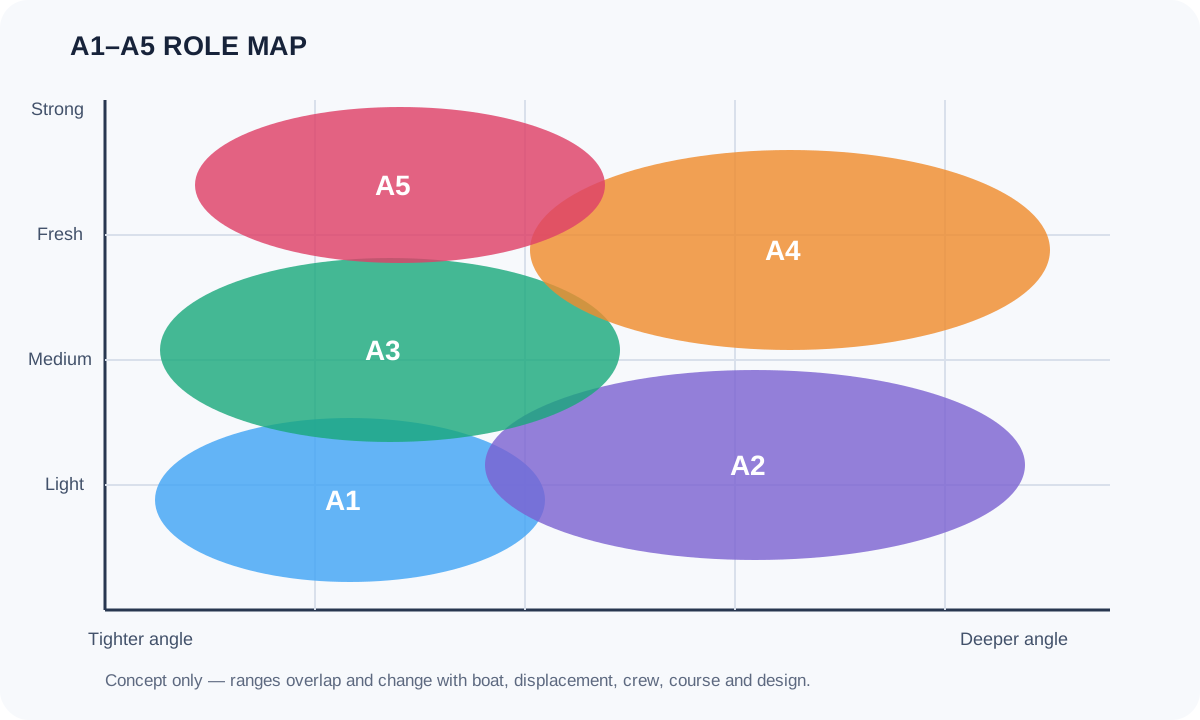
The five roles
| Main job | Typical shape | Typical cloth | |
|---|---|---|---|
| A1 | Very light air across a wide downwind arc | Fullest shape and maximum volume | Lightest |
| A2 | All-purpose running | Full shoulders and a broad working range | Light to moderate |
| A3 | Reaching | Flatter shape, narrower shoulders and a tighter luff | Moderate |
| A4 | Heavy-air running | Controlled fullness and greater stability | Heavier |
| A5 | Heavy-air reaching | Flattest, narrowest and most specialised | Heaviest |
You will often hear that odd numbers reach and even numbers run. It is a useful shorthand from A2 upward, but it is not a complete rule: A1 is a very-light-air sail that can cover a broad range of downwind angles.
Why A2 is the normal single-sail answer
An A2 gives away the extremes in exchange for the widest useful range. Its full shoulders rotate into clear air at deep angles, while its cloth and shape remain manageable as the breeze fills in.
That makes it the normal recommendation for a cruising boat buying one gennaker and a common general-purpose sail in club-racing inventories.
When another role is appropriate
Choose a more specialised role only when the sailing requirement is genuinely specialised:
| Your requirement | Direction of change |
|---|---|
| Reliable very light air | Lighter and fuller than an A2 |
| Reaching is the main job | Flatter, narrower and tighter-luffed |
| Reliable fresh wind | Heavier and more controlled |
| A complete racing inventory | Divide the wind and angle range between several sails |
Do not configure from the A-number alone. Record the target wind, apparent-wind angles and normal crew in Note so Sailmaker Review can confirm that the geometry and cloth express the intended role.
The handling decision comes next
A sock-launched sail and a top-down furling sail cannot share exactly the same geometry. Confirm Handling Systems before the final dimensions and shape are approved.