
An in-mast mainsail is shaped by one requirement: it has to roll into a slot in the mast and come back out again, every time, without jamming. That requirement decides most of the sail.
Read this instead of Battens and Reefing
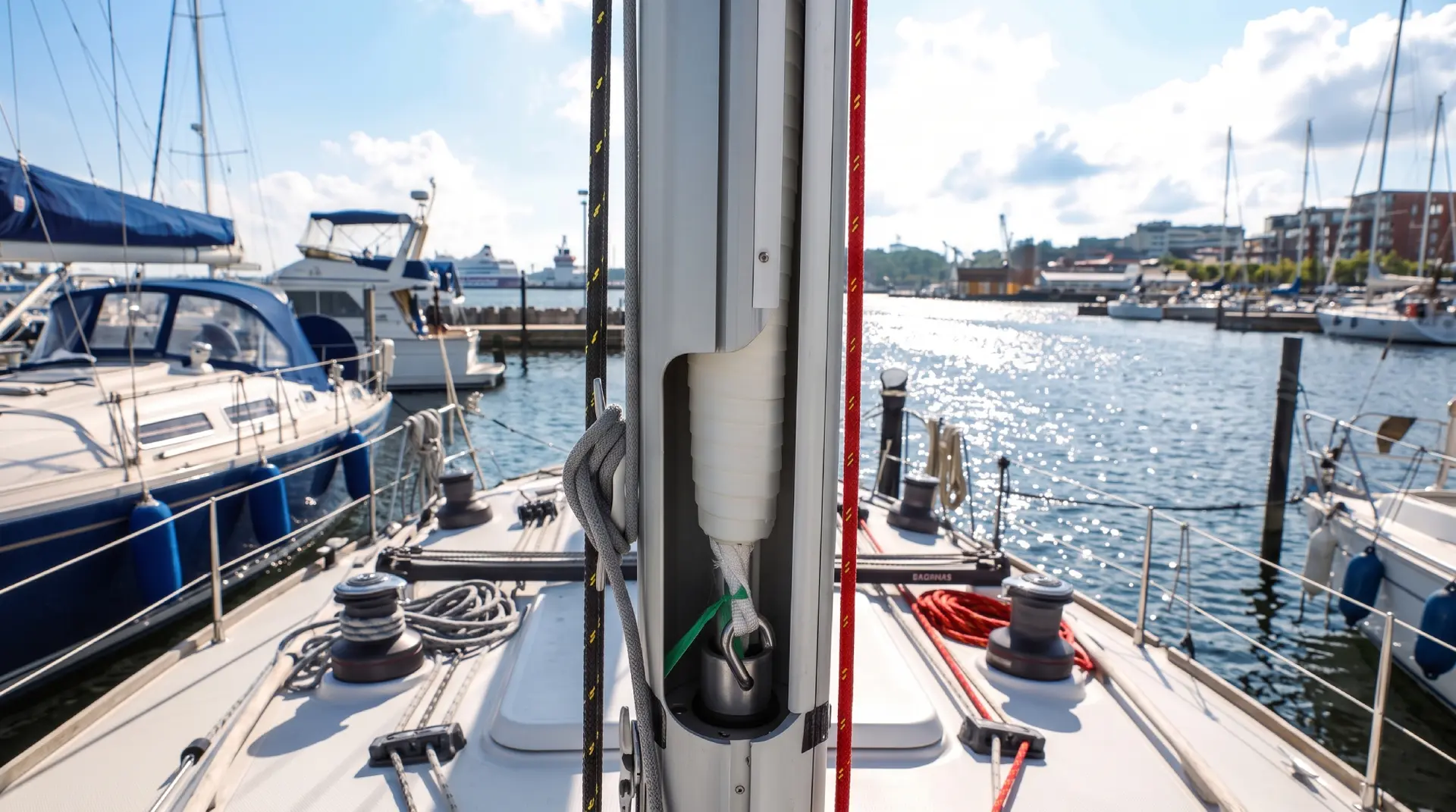
If your boat has in-mast furling, this page replaces Battens and Reefing. Everything else in the sequence still applies.
Reefing: there is nothing to specify
An in-mast sail has no reef points. Area is reduced by rolling the sail in and stopping wherever you want, so it reefs continuously rather than in fixed steps.
This is the real advantage of the system, and it is why nothing on the sail corresponds to a reef tack, a reef clew or a reef diamond.
No roach
The leech has to roll in with everything else, and a roach puts extra cloth at the outside of the roll where it accumulates fastest.
So an in-mast mainsail has no roach. The leech is cut straight, and more often with a hollow — a concave curve, so the leech falls inside the straight line from head to clew and there is less cloth to roll.
That hollow is area given away deliberately. It is the price of the system: an in-mast mainsail is meaningfully smaller than a standard mainsail on the same rig, and what you buy with the difference is furling from the cockpit.
Battens
No horizontal battens. A horizontal batten cannot roll around a vertical foil.
Vertical battens are possible, running up and down the sail so they roll with it rather than against it. They allow a little more leech support than a battenless sail.
They are not free. A vertical batten is a stiff object lying close to where the sail wraps, and its thickness accumulates through every turn — so it can make the sail harder to roll into the mast. Whether they are worth having depends on your furler, the clearance inside the extrusion, and how reliably the existing sail furls.
If your current sail already jams or is stiff going in, adding vertical battens is the wrong direction.
The clew
The clew of an in-mast sail runs on its own arrangement at the boom, normally including a sheave, so the outhaul can pull the sail out along the boom and let it back in under control. It is not the same fitting as a standard mainsail’s clew slide or strap.
No foot line, and a leech line that turns
There is no foot line on an in-mast sail. That is a property of the system rather than a general rule about loose-footed sails — the foot arrangement and what has to roll into the slot leave no place for one.
The sail still needs a leech line, but its adjusting end cannot come out where it would on a standard sail — that part of the sail is inside the mast, or about to be. The leech line is routed with a deliberate turn so the adjusting end comes out where it can be reached and does not foul the roll.
UV protection
When the sail is rolled away, a strip along the edge that finishes on the outside stays exposed — in practice the part of the foot and leech left showing at the slot.
That strip carries UV protection, and which side it goes on is set by the direction your furler rolls, not chosen. Photograph the sail half rolled and it will be read off the photograph.
Layer thickness is the whole problem
Everything above comes back to the same thing. Each turn of the roll sits on top of the last, so any local thickness is multiplied by the number of turns. A patch, a heavy seam, a piece of hardware or a doubled edge that is unremarkable on a standard mainsail becomes a bulge that grows with every wrap.
This is why an in-mast sail is not a standard mainsail with the battens taken out.
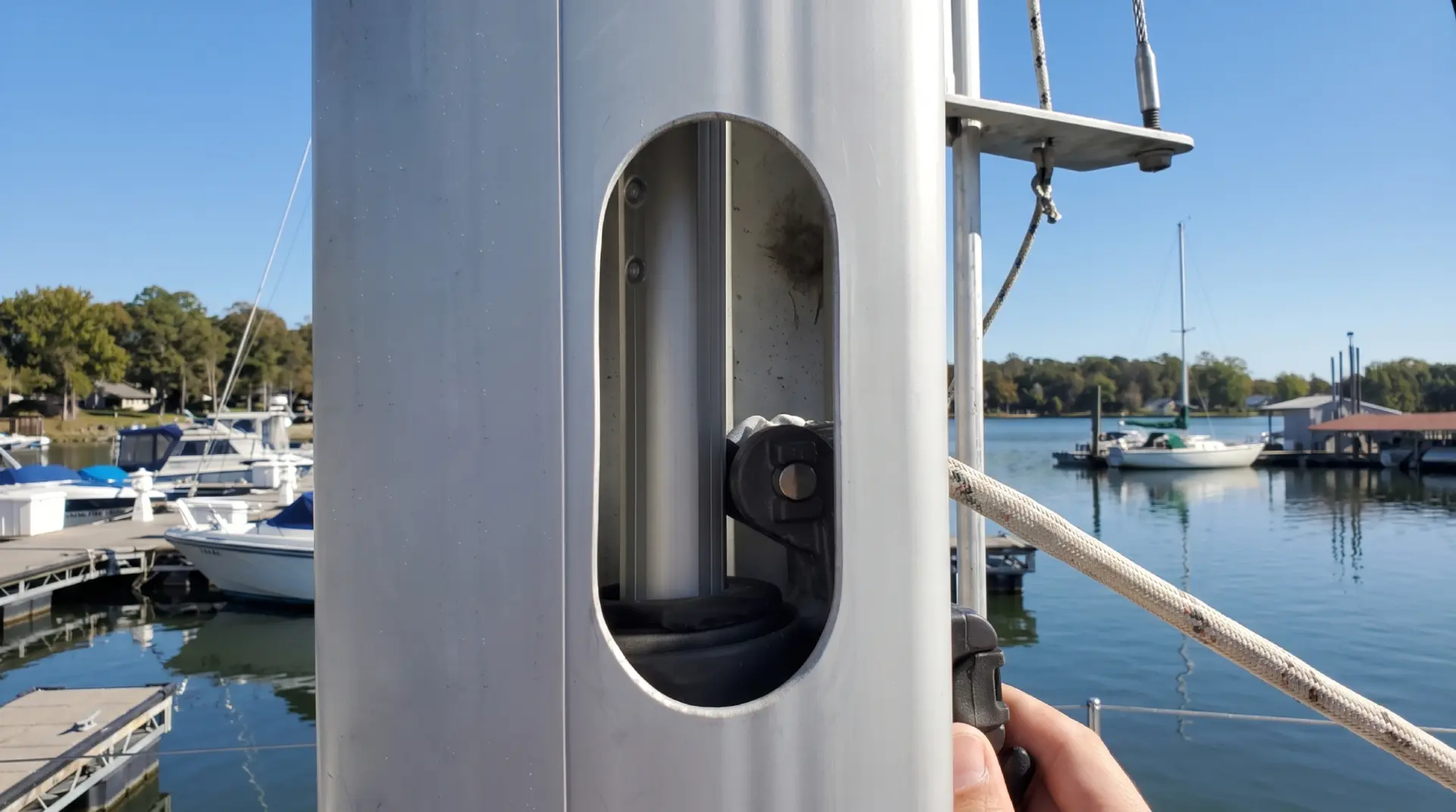
- The mast from the side, showing the slot, with the sail rolled away.
- The furling gear at the base of the mast, and any maker’s plate or model number.
- The tack area and the clew arrangement at the boom.
- The sail half unrolled, so the leech and the roll direction are visible.
- The sail partly unrolled, if you can, showing any existing vertical battens.
If the existing sail has ever jammed, tell us where in the roll it happened and in what conditions. That single piece of information is often worth more than any measurement.
Configuring this at SurgeSails
Set Mainsail Type to In-Mast Furling. Reef Count disappears, because there is nothing to set. Batten Layout offers vertical or none. UV Protection appears, with the side it applies to.
Give us the furler make and model with your photographs. Unlike in-boom systems, an in-mast sail does not need a manufacturer’s drawing — the system is identified from the model and the photographs.