
Head, tack and clew on a headsail carry higher loads for their size than the corners of a mainsail, because a headsail’s entire load reaches the boat through three points with nothing else holding the sail up. Each has to match hardware already fitted, in spaces that are usually tighter than they look.
The head
The head takes the halyard, and on a furling sail it takes the top swivel as well.
What has to be established is the fitting itself — a ring, a webbing loop, or a pressed eye — and the space it works in. On a furling sail the constraint is usually vertical: the head has to be able to rise far enough that the luff can be properly tensioned before the head fitting reaches the swivel. A sail that runs out of hoist before the luff is tight is a sail with a sagging leading edge and there is nothing to be done about it afterwards.
The other consideration is alignment. The head fitting has to let the sail rotate freely with the foil as it furls, without the halyard wrapping around the forestay above the swivel. Halyard wrap is a furling system problem rather than a sail problem, but the head fitting and the angle of the halyard influence it.
The tack
The tack sits in the most constrained space on the sail.
On a furling boat it is immediately above the drum, and the available height between the top of the drum and where the sail must start is often small. Every part of the tack arrangement — the fitting, the shackle or hook, any pennant — is consuming that height.
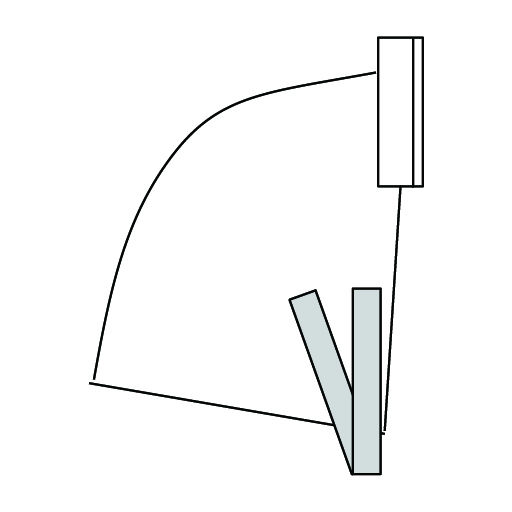
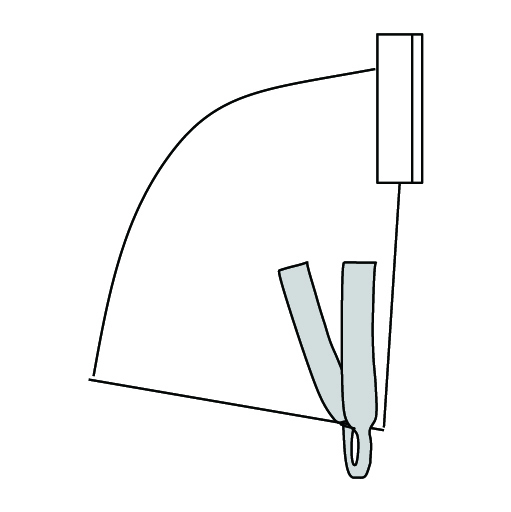
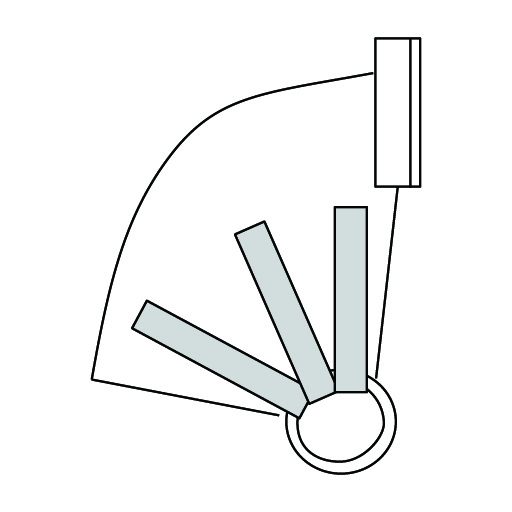
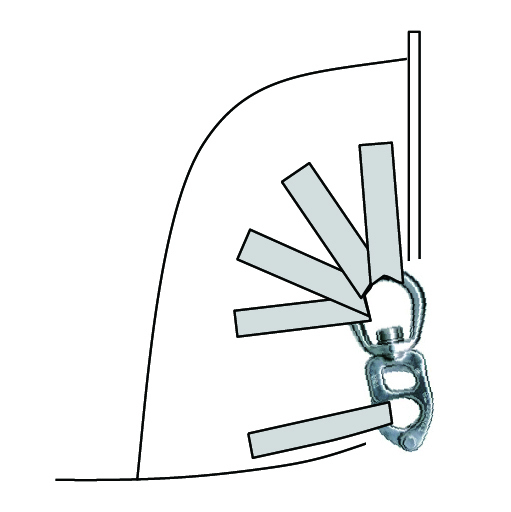
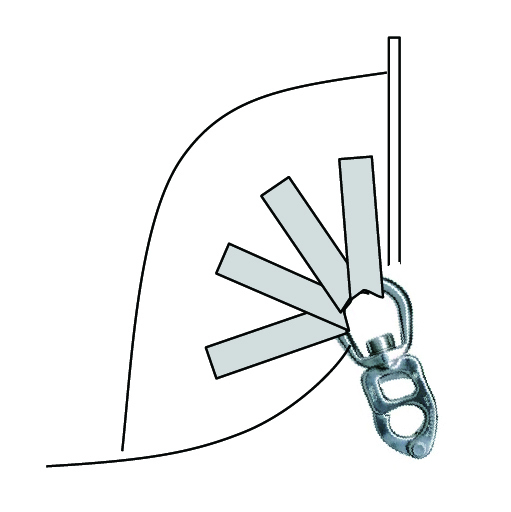
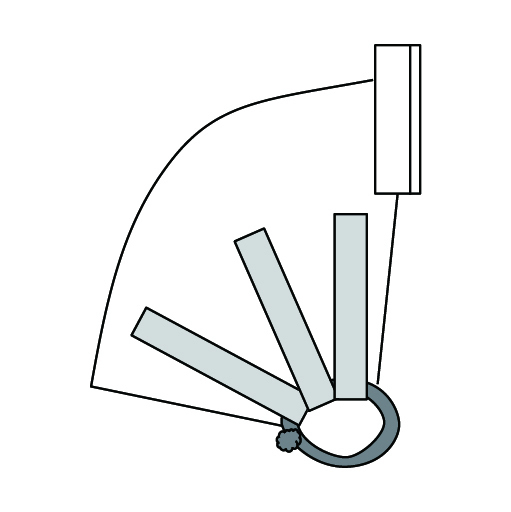
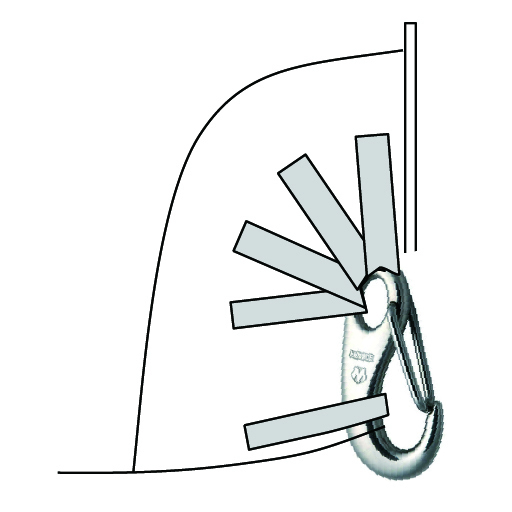
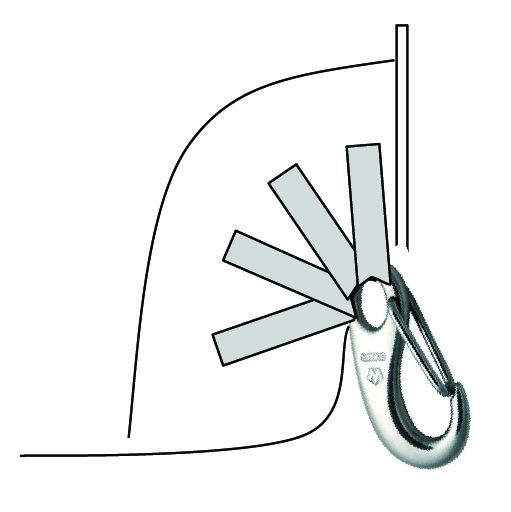
The arrangement matters as much as the fitting. Several families are in use and they behave differently:
A fixed attachment holds the sail at a set angle. Simple and positive, and it makes the tack take whatever distortion the load angle imposes.
A free-hanging attachment lets the sail align itself with the load. The tack area stays cleaner under varying loads, which matters on a sail whose sheeting angle changes a lot.
A hook can be operated with one hand, which matters on a sail that is set and struck rather than furled.
A soft shackle is light, strong and quiet — no metal fitting swinging against the foredeck or the foil.
Which is right follows from what is on the boat, how often the sail is handled, and how much height is available.
Tack attachment reference
These are the eight tack families currently distinguished in the configurator. The drawing identifies the finished arrangement; the exact ring, shackle or hook model is confirmed separately against the boat and the design load.
The clew
The clew takes the sheets, and both of them, on both tacks, for the life of the sail.
Two things decide its construction. The load, which is the highest single load on the sail and arrives at a varying angle depending on where the lead is set and how far the sail is eased. And the handling, because the clew is what swings across the foredeck on every tack, and it is what hits the mast, the rigging and occasionally the crew.
That second point drives more than it appears. A heavy metal ring at the clew of a genoa is a hazard on a boat sailed with people on the foredeck, which is why soft attachments and webbing arrangements are common on cruising headsails despite metal being the obvious answer to the load.
Where the sail furls, the clew also has to roll up neatly. Bulk at the clew accumulates through the roll.
Cut back and cut up
The corners are not placed at the theoretical intersections of the edges. They are offset to clear things.
Tack cut back moves the tack aft of where luff and foot would meet. Tack cut up raises it. Together they clear the drum, the fitting, the pulpit and anything else in that crowded space.
These are dimensions of available space, taken from the boat. They are not proportions of the sail and they are not styling. And they change the finished luff and foot, so they are part of sizing the sail rather than an adjustment made afterwards.
The reliable way to establish them is photographs of the tack area with the existing sail attached and with it removed, with a ruler in frame — not a tape measure held against a fitting with no obvious datum.
Reinforcement
Each corner needs its load spread into the body of the sail before it reaches ordinary cloth, over a distance appropriate to how that cloth distributes load.
On a furling headsail there is a second constraint that a mainsail does not have: the reinforcement has to roll up. A corner patch built for load alone can be thick enough to make a visible bulge through the roll, and that bulge accumulates. Corner construction on a furling sail is therefore a compromise between spreading load and staying flat, which is one of the reasons a furling genoa and a hanked jib of the same size are not built the same way.
Layer counts, orientations, ring backing and stitching are engineering data set for the sail as a whole. They are not owner decisions.
Configuring this at SurgeSails
Head Corner, Tack Corner, Tack Type and Clew Corner select the arrangement at each corner, with the specific fitting following from the type chosen. Tack Cut Back and Luff Tape Tack Cut Up position the tack.
Reinforcement layout, ring backing and webbing specifications are not configurable. If the boat’s own fittings are worn, distorted or repaired, that is a question for a rigger before a sail is built to match them.