
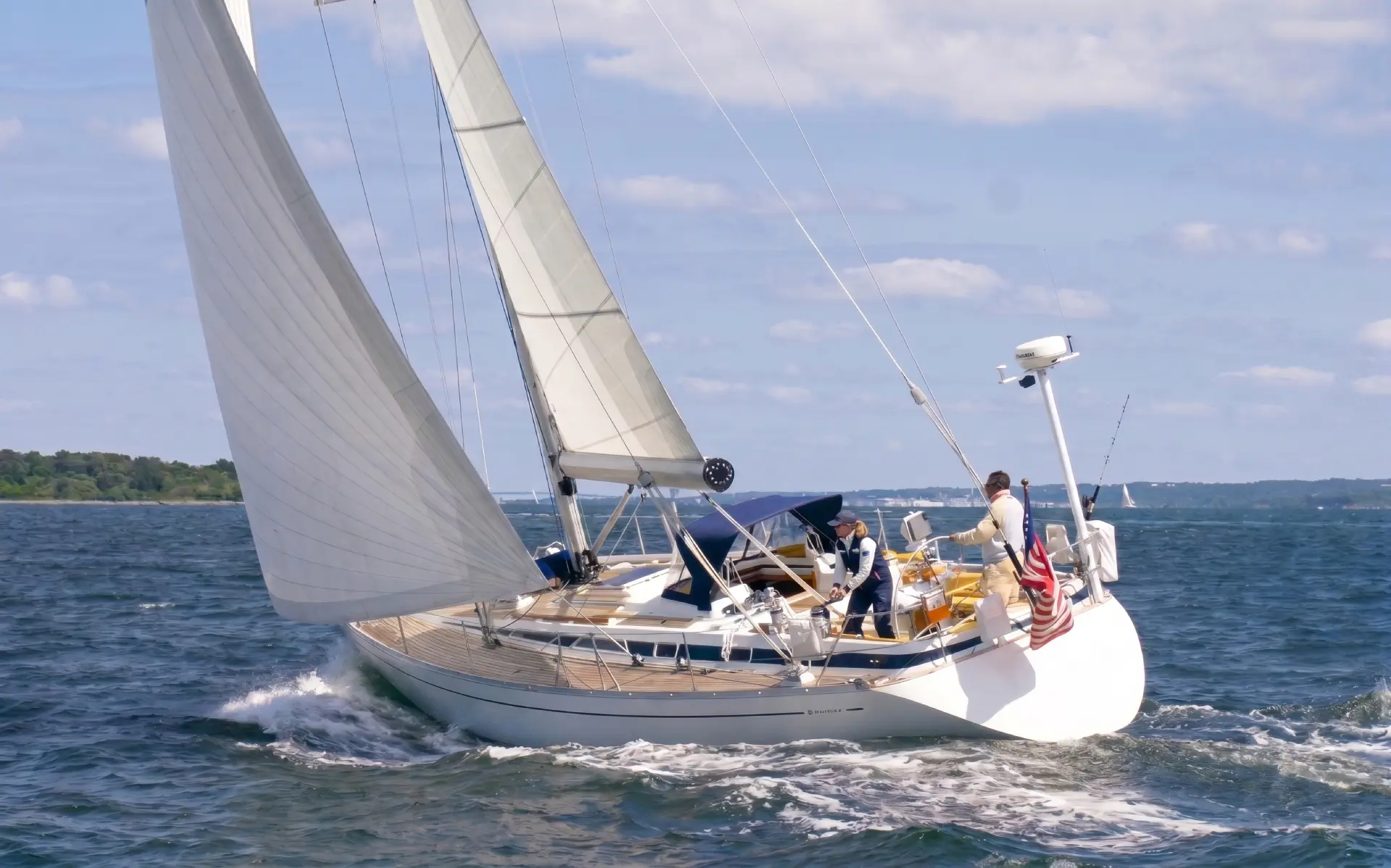
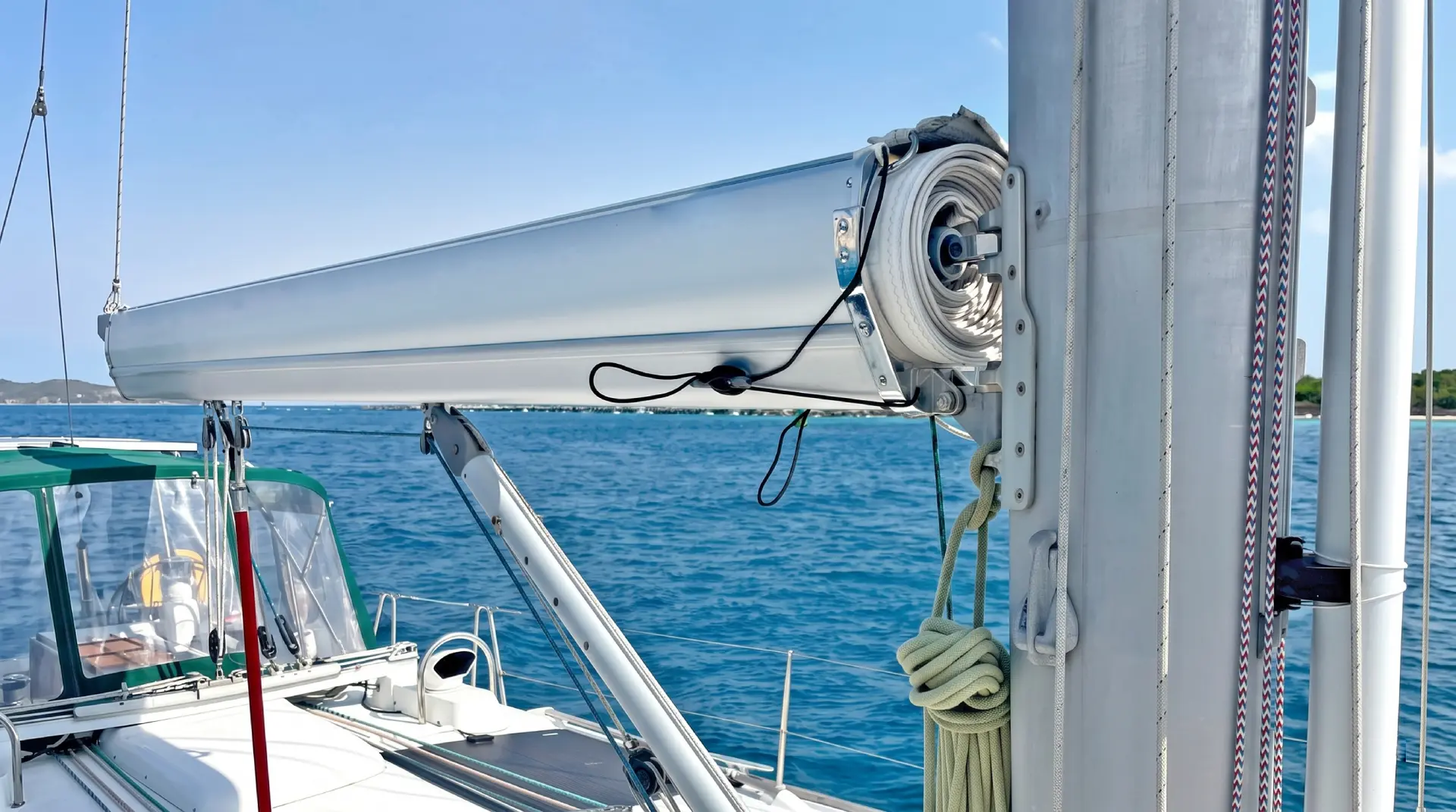
An in-boom mainsail rolls up inside the boom around a horizontal mandrel. Compared with in-mast furling it keeps far more of a conventional mainsail — full battens, useful roach, real draft. What it demands in return is that the sail is built to the boom manufacturer’s specification, not to a general shape.
Read this instead of Battens and Reefing
If your boat has in-boom furling, this page replaces Battens and Reefing. Everything else in the sequence still applies.
We need the boom manufacturer’s drawing
This is a hard requirement. An in-boom mainsail cannot be built without the vessel-specific drawing and dimensional data from the boom manufacturer.
That document is not a formality. It carries dimensions that exist nowhere else and cannot be derived from the boat — typically including:
- The tack angle, taken between tack and head and between tack and clew
- The height above the foot to the centre of the lowest batten
- Where the foot cut-back begins, and how much
- The foot bolt rope size, and where along the foot it starts and finishes
- The finished foot length and foot round
- The distance from the luff to the centreline of the boom’s support bracket
- How much the sail must be cut up to clear that bracket
- Batten angles and inner-end details
- The luff length, where it is not otherwise established
Different manufacturers specify different sets, and the figures are specific to your boat and your boom — not to the model in general.
If you do not have the drawing, give us the boom make, model and size and we will request it. Production does not start until it exists.
Reefing: you reef to a batten
An in-boom mainsail is reefed by easing the halyard and winding the sail onto the mandrel with the furling line, from the cockpit. Many systems allow this without heading up into the wind, which is their real advantage over slab reefing — but how far off the wind a given system will furl reliably varies by make, so follow what yours specifies.
Where you stop is not arbitrary. The sail is wound down until a full batten sits directly under the mandrel. At that position the batten lies parallel to the boom, the roll is flat and even, and the sail’s new foot is a straight batten rather than loose cloth.
So each full batten is a reef position, and the number of battens is the number of reefs available. Stopping between battens leaves unsupported cloth at the top of the roll, which is what produces an uneven wind-on.
The luff is normally marked where each batten enters the feeder, so the position can be found by eye.
Full battens, and where they are allowed to be
Full battens are required, not optional. They lie parallel to the boom, roll flat with the sail, and they are what makes the reef positions work.
Several things about them are set by the system rather than by preference:
Batten angle. The battens are not square to the leech. They are set at specific angles so that they lie parallel to the boom when the sail is wound on, and the angles come from the drawing. Getting them wrong is one of the more common ways an in-boom sail furls badly.
Batten pockets run parallel to the boom, not perpendicular to the leech.
Batten position is constrained by the boom’s support bracket. A batten must not finish at the bracket centreline — it has to be moved clear of it, and the sail’s batten heights are adjusted accordingly.
The lowest batten is usually treated differently from the rest — often placed on the opposite side of the sail and stopping short of the luff.
Batten stiffness scales with the boat, and with the sail’s size and roach. It is specified rather than chosen.
The inner ends must be built exactly as drawn. These are the parts that enter the boom, and the manufacturers are specific about how the pocket, the webbing that takes the batten thrust, and the guide pads at the bolt rope are made.
The outer end must finish flush with the leech, attached so that it adds no bulk.
The leech is built up, and is not twisted
Two things about the leech that are the opposite of a normal mainsail.
It is plied. Areas of the leech are built up in two and three layers of the same cloth as the sail. This is not general reinforcement — it is what gives the leech the body it needs to wind on evenly, and these systems treat it as essential rather than optional.
Twist is not cut into it. A conventional mainsail is drawn with the leech opening progressively toward the head. In-boom manufacturers instruct sailmakers not to build that in, because a tight leech is what makes the sail wind on evenly — the leech is opened in use by unloading the boom instead.
This is a genuine trade against normal aerodynamic shape, and it is the manufacturer’s call rather than ours. It is one of the reasons an in-boom mainsail is built to the system’s drawing rather than to a general design.
Luff round is tied to your mast’s prebend
The luff round on an in-boom sail is limited relative to how much the mast is prebent — the manufacturers specify a ratio rather than leaving it to the designer. A mast set up very straight gets a correspondingly small luff round, and the draft is obtained through seam shape instead.
So the mast’s prebend is a real input. If you know it, tell us; if you do not, it is one of the things worth asking your rigger for.
The luff tape goes straight onto the sail
The luff tape is fitted directly to the sail with no reinforcing tape underneath it. Reinforcement there interferes with furling, and where a cloth genuinely needs support the manufacturers permit only a single light layer on one side, and only on larger boats.
A short length of bolt rope is left exposed at the bottom of the luff tape to allow for shrinkage.
No metal fittings on the sail
This one surprises people, so it gets its own heading.
Cringles and metal fittings are not used anywhere on an in-boom sail unless the manufacturer indicates them. A cringle can catch the top lip of the boom as the sail winds on and tear the sail. Tack patches are kept to a minimum for the same reason — bulk near the tack is bulk going into the boom.
Leech line cleats are small and are fitted on the side the sail rolls from.
The head is normally a conventional ring rather than a headboard.
Alignment is the system
Three things have to work together for the sail to wind on evenly:
The boom angle. In-boom systems have a correct angle relative to the mast for furling, held by a rigid or spring-loaded vang. They tolerate some movement, but outside that band the sail creeps along the mandrel toward one end.
The luff feed. The luff has to enter the boom’s feeder at the right place as the sail descends.
Halyard and furling line together. The halyard controls the rate the sail comes down; the furling line controls the roll.
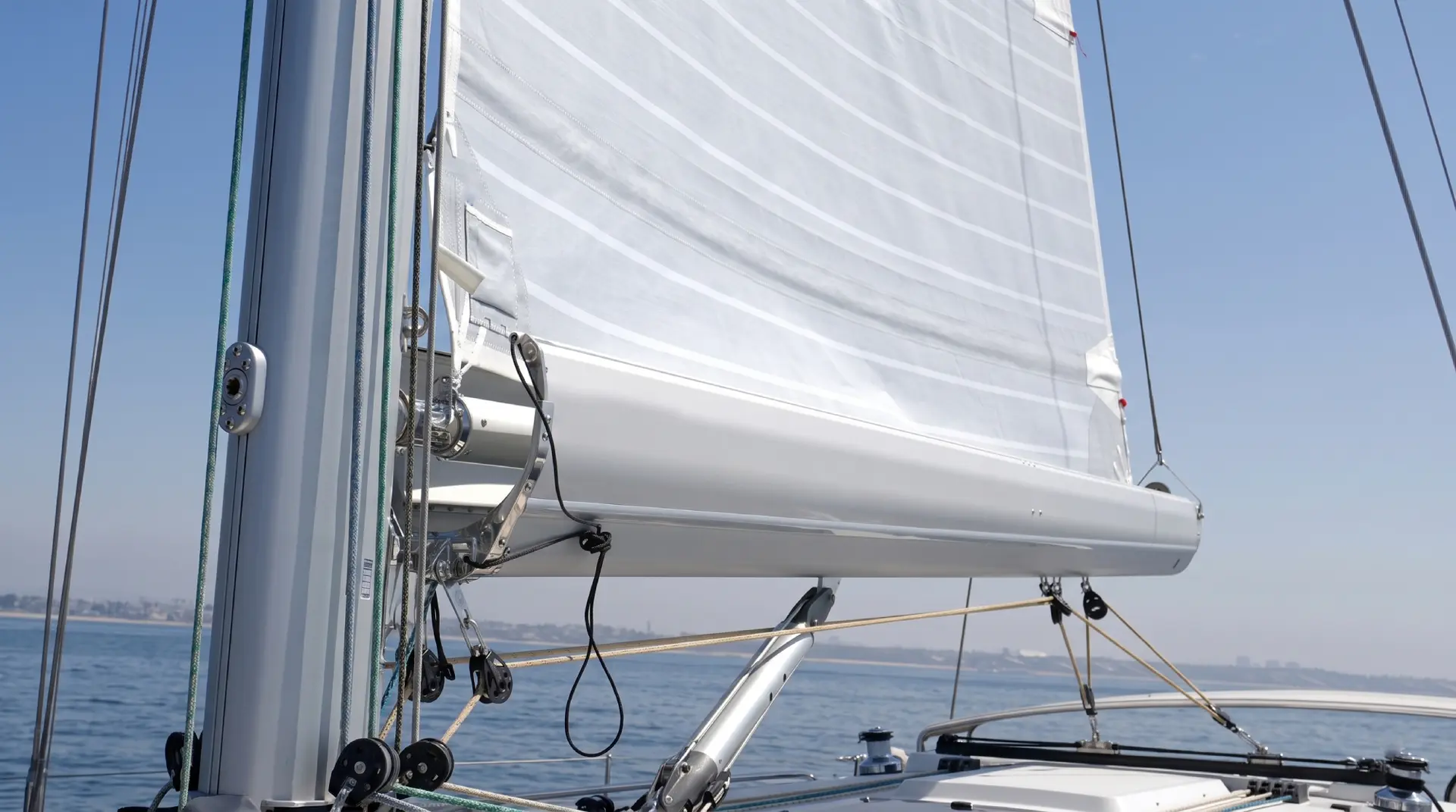
The sail rolls onto the mandrel from one side, and whichever face finishes outermost is the one that stays exposed. That side is set by the system, not chosen.
Many of these systems suggest a UV strip running the full length of the leech. It protects the sail, it helps the leech wind on, and it means the boom cover does not have to go on every time.
What to photograph
- The boom from the side, whole, with the sail up.
- The forward end of the boom at the gooseneck, showing the feeder and the luff entry.
- The support bracket.
- The mast track and the luff hardware on the existing sail.
- The clew and outhaul arrangement.
- Any maker’s plate or model number on the boom.
- The vang.
If the existing sail has ever wound on unevenly — creeping toward one end of the mandrel, bunching at the luff, or refusing to come down past a point — describe where and when. That behaviour usually points at alignment or batten geometry, and it is far cheaper to correct in a new sail’s design than to chase afterwards.
Configuring this at SurgeSails
Set Mainsail Type to In-Boom Furling. Reef Count disappears, because the reef positions are the batten positions. UV Protection appears with the side it applies to.
The manufacturer’s drawing is not a form field. Attach it, or give us the boom make, model and size, in Design Note or with your photographs.
Whether an existing in-boom system is in good order, and whether its vang and boom angle are correctly set up, are questions for a rigger. A new sail is built inside the boundaries of the system as it stands.