
The one choice on a standard mainsail that has to be made rather than accepted, because everything on the luff follows from it. Battens decide how the sail behaves when it comes down and how much area it can carry high up — and a full batten needs hardware on the mast to carry it.
What they do
The leech of a mainsail is unsupported. Left alone it flutters, and the area outside the straight line from head to clew — the roach — has nothing holding it out.
A batten is a stiff strip in a pocket running forward from the leech. It holds that part of the sail’s section, which lets the sail carry roach and makes it fold in the same place every time instead of spilling wherever the wind takes it.
The arrangements
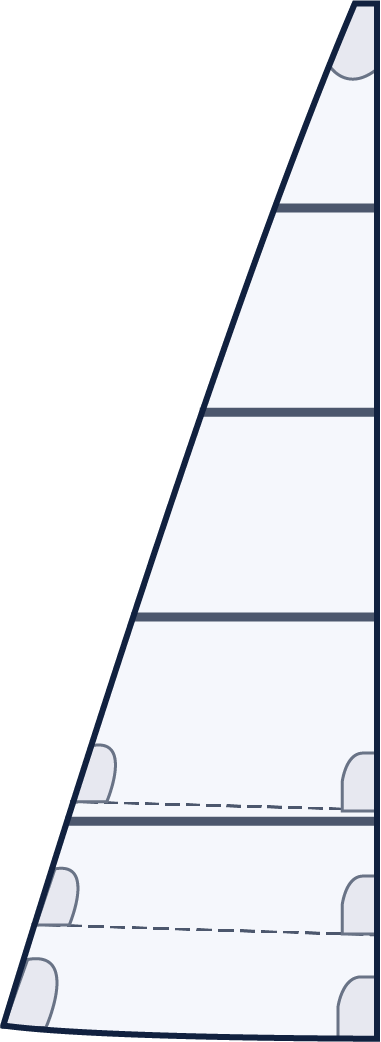
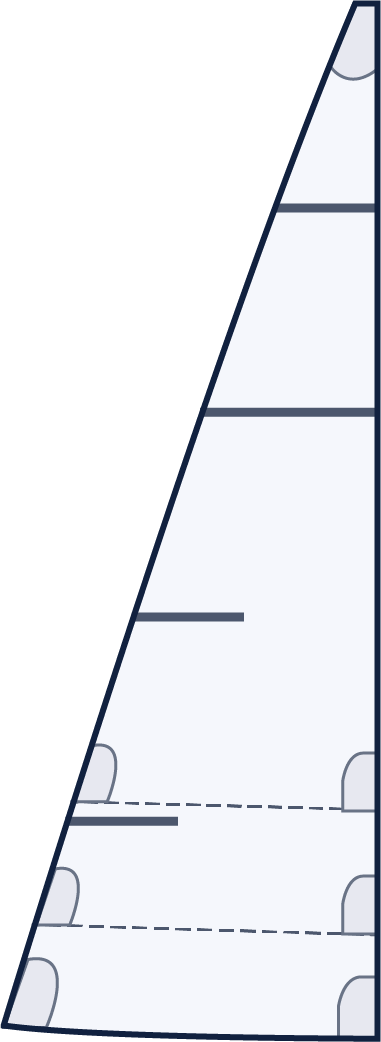
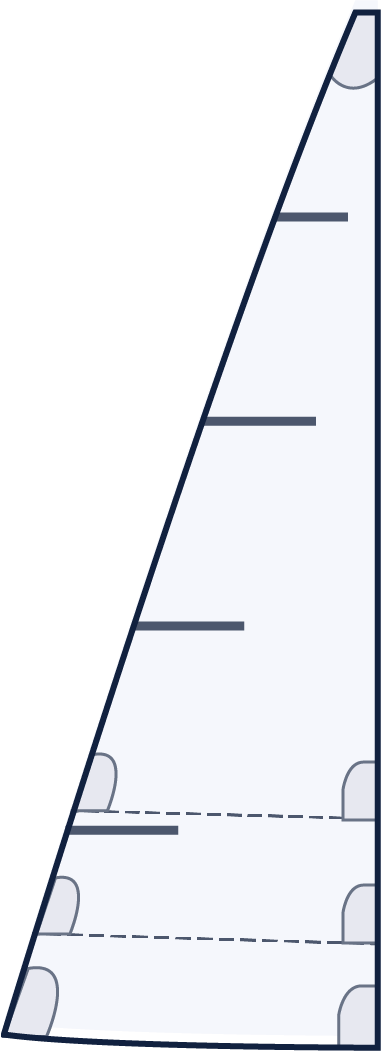
Short battens run forward from the leech and stop partway. They keep the leech from fluttering and need nothing but a pocket in the sail — no hardware at the luff, nothing to service. The limit is that they can only support so much roach, so the outline stays moderate.
Full battens run the whole way from leech to luff. They hold the sail’s entire section, which allows more roach and makes the sail fold down on itself very predictably — the reason full-batten mains and lazy cradles go together.
The cost is real. A full batten under leech tension is in compression along its length, and that compression is pushed forward into whatever holds it to the mast. A plain slide in a groove has nothing to react it against, so a full-batten mainsail is normally carried on batten cars on a track: hardware on the mast, a receptacle built into the sail at each batten, and a connection between the two that has to be right. Each extra full batten adds a car, a receptacle, weight aloft and something else to service.
Mixed — full battens where the roach is, short battens below — is where most cruising mainsails end up. Predictable folding and useful roach at the top, without cars at every position down the luff.
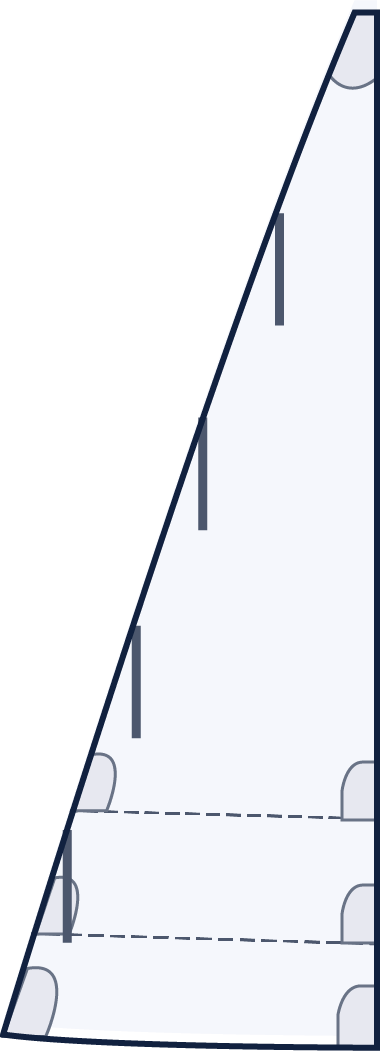
Vertical battens run up and down the sail so they can roll around a vertical foil. They apply only to in-mast furling mainsails, where the system has enough clearance to accept them.
How to decide
Start from how the sail comes down, not how it goes up. Hoisting happens once; lowering is the part that happens in a hurry, sometimes short-handed, sometimes in more breeze than anyone wanted.
Full or mixed if the sail drops into a lazy cradle or stack pack, if you sail short-handed and want the sail to stow itself, if you want the extra area, or if your current sail flogs badly at the head.
Short if you want the simplest sail to own and service, if the boat is small enough that folding by hand is no chore, or if the mast has no track that will take batten cars.
That last one is worth settling early: fitting a track is a rigging job, not a sail decision, and it belongs before the sail is ordered.
What follows
Once the arrangement is fixed, the luff hardware follows from it. Full battens need a load-bearing connection at the luff end — usually batten cars, sometimes a plain slide or another fitting — and the sail has to be built to whatever is there. We need the model, the count and how each one connects: Dimensions and Fit.
Configuring this at SurgeSails
Batten Layout sets horizontal, vertical or none; Full Battens and Short Battens set how many of each. Vertical battens apply only to in-mast furling sails.
With full battens, Batten Car and Luff Receptacle appear. The car has to match what is already on your mast.
Batten profiles, pocket widths and pocket construction are set from the arrangement, the sail’s size and the cloth — Battens, Receptacles and Pocket Finishes if you want to know how.