
This is the design explanation behind the numbers, not the measuring checklist. For the two practical routes — measuring an existing sail or measuring the boat when no sail exists — start with Dimensions and Fit. This page explains how those dimensions define the outline, roach and area.
The boat’s dimensions are not the sail’s dimensions
P is the usable height on the mast for the mainsail. E is the usable length along the boom. Together they describe the space available on the spars.
The finished sail is smaller than that space, and it has to be. The headboard occupies height at the top. The tack fitting and the gooseneck occupy space at the bottom. The clew fitting and the outhaul car occupy length at the aft end. There has to be enough halyard travel left to tension the luff, and enough clearance that the boom can be eased without the sail fouling anything.
So a rig dimension is where a sail dimension starts, never where it ends. Taking P and calling it the luff produces a sail that cannot be hoisted.
Where a boat is in a rig database, that record is a good starting point and a poor final authority. It describes the boat as designed, not the boat as it is now: masts get replaced, booms get changed, and previous owners modify things without telling anyone.
The three edges are not independent
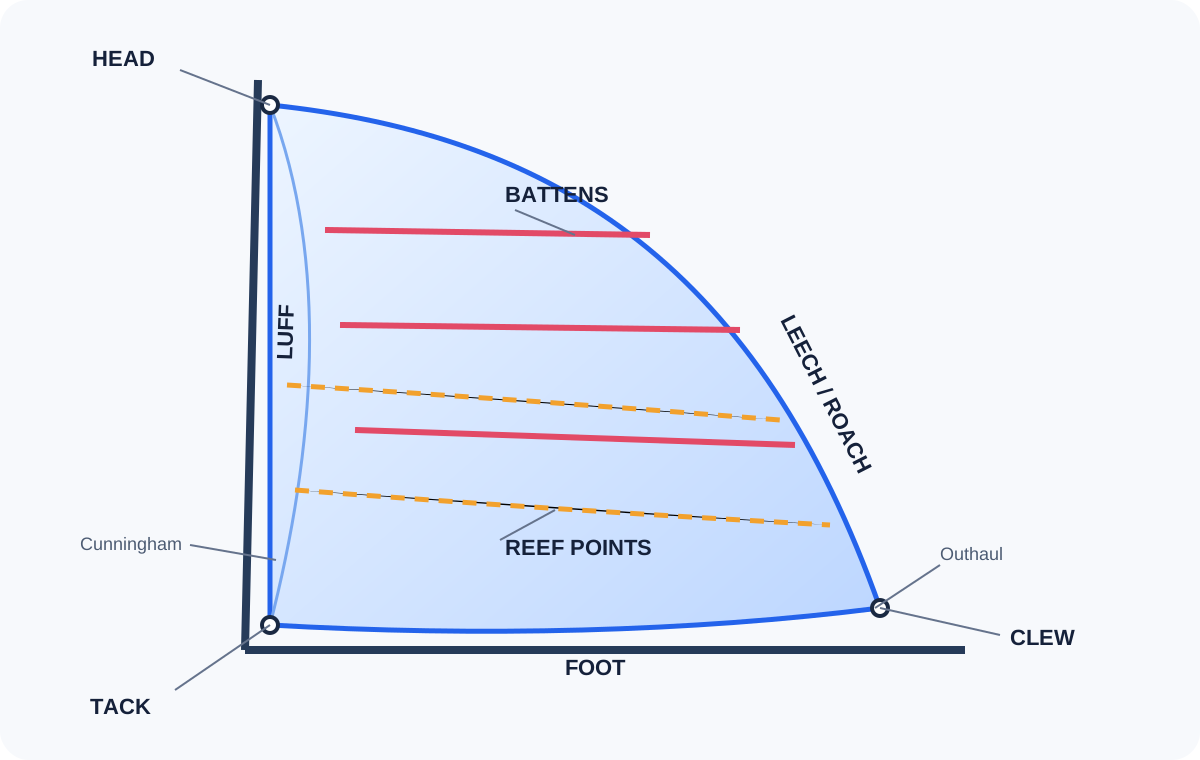
Luff sets the working height up the mast. Foot sets the working length along the boom. Leech is not chosen at all — it is what results from the outline drawn between the head and the clew.
Change any one and everything moves. A longer foot changes the sheeting angle and the outhaul’s range. A longer luff changes where the reefs sit, because reef positions are placed along it. The leech changes with both, and with the roach.
Roach: what it buys and what it costs
Roach is the area of sail outside the straight line from head to clew.
What it buys is area high up, where the wind is stronger and less disturbed, and where a given area of sail does more work than the same area near the deck. It is the most efficient area on the sail.
What it costs is fourfold, and all four are practical rather than theoretical:
Batten support. Roach has nothing holding it out except battens. Add roach and the batten requirement grows with it — first in stiffness, then in length, and eventually into full battens with cars on the mast.
Backstay clearance. On a boat with a backstay, the leech has to pass the backstay every time the boat tacks or gybes. Too much roach and it does not — it catches, and the sail wears at the point of contact. This is the hard limit on many boats, and it is set by the rig geometry rather than by preference.
Stowage bulk. More cloth high up means more cloth to flake, and a fuller cover.
Weight aloft. Area at the top of the sail is the worst place to carry weight, and the battens supporting it are up there too.
The result is that roach is a boat-by-boat answer. A cruising mainsail with a backstay ends up with moderate roach because the rig will not allow more. A racing boat with running backstays or a swept-spreader rig and no backstay can carry a great deal.
The girth measurements
The width of the sail at various heights is recorded separately from the edge lengths, because the edges alone do not describe the outline.
MHB is the width at the head — effectively the headboard width. MUW, MTW, MHW and MQW are widths at the upper, three-quarter, half and quarter heights.
These do two jobs. They describe the outline precisely enough that a sail can be reproduced or compared without ambiguity, and where a boat holds a rating certificate, they are the measurements the rating rule is interested in. “A bit more roach” is not a specification; a set of girths is.
Area
A mainsail has more than one area, and they are not interchangeable.
The actual area of the finished sail is what it sounds like.
The rated area under a rating rule is calculated by that rule’s own formula from the girths, and is deliberately not the same number.
Confusing these is a common source of arguments about sail size. Any statement about a sail’s area should say which area it means.
Where the shape actually comes from
Everything above describes the outline — the sail seen flat. The three-dimensional shape it takes when flying comes from the luff curve, the way the panels are shaped, and how the cloth behaves under load. That is a separate subject: How Mainsail Shape Works.
Configuring this at SurgeSails
Luff, Leech, Foot and Head are in the main form. In the Pro view, Rig P and Rig E can be entered as the rig reference they are, and the girths — MUW, MTW, MHW, MQW — become available for owners who need the outline specified precisely or who hold a rating certificate.
Roach is not a field. It is the consequence of the girths, the batten arrangement and the clearances on your rig, and it is set from those.